
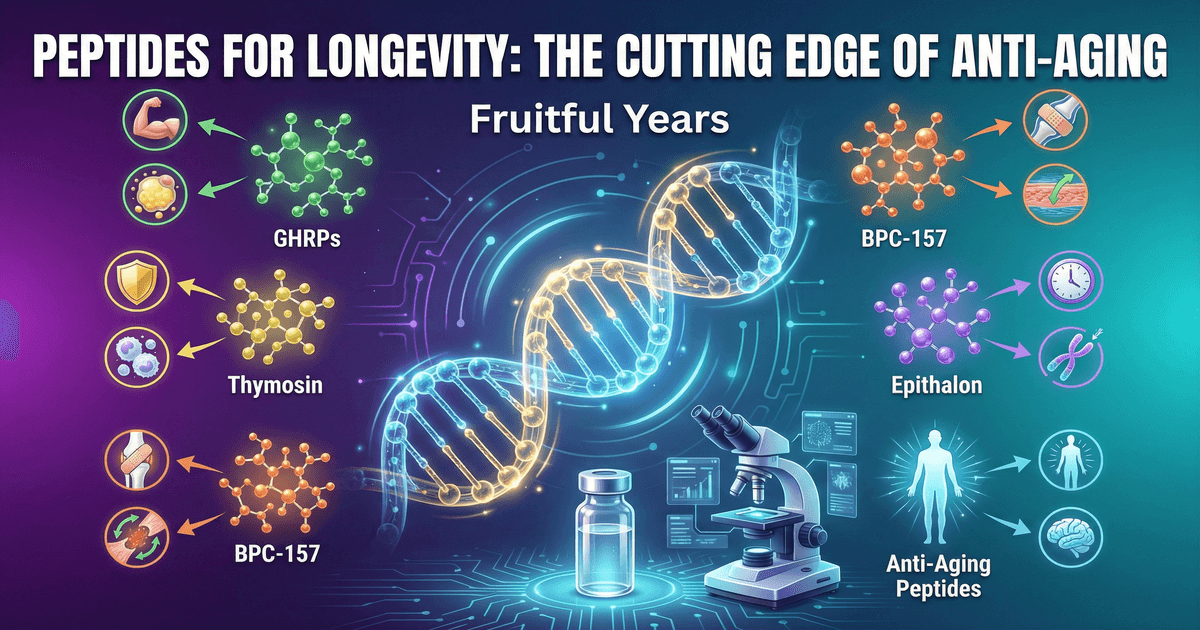
# Peptides for Longevity: A Review of BPC-157, CJC-1295, and More
In the world of biohacking and longevity optimization, peptides have emerged as one of the most talked-about (and controversial) interventions. From professional athletes to Silicon Valley executives, people are turning to these short chains of amino acids in hopes of accelerating recovery, building muscle, improving sleep, and even reversing aspects of aging.
But what exactly are peptides? Do they work? And most importantly, are they safe?
This article provides an objective, science-based review of the most popular longevity peptides, including BPC-157, CJC-1295, Ipamorelin, and others. We’ll explore the research, discuss potential benefits and risks, and help you make an informed decision about whether peptides belong in your longevity protocol.
## What Are Peptides?
Peptides are short chains of amino acids—the building blocks of proteins. While proteins can contain hundreds or thousands of amino acids, peptides typically contain 2-50. Your body naturally produces thousands of peptides that act as signaling molecules, hormones, and regulators of biological processes.
**Therapeutic peptides** are synthetic or naturally derived peptides that mimic or enhance these biological functions. They’re used in medicine to treat conditions ranging from diabetes (insulin is a peptide) to osteoporosis (PTH peptides).
In the longevity and biohacking space, peptides are used for:
– Tissue repair and wound healing
– Growth hormone optimization
– Immune system modulation
– Cognitive enhancement
– Sleep improvement
– Fat loss and muscle gain
**Important distinction:** Most longevity peptides are **not FDA-approved** for anti-aging or performance enhancement. They exist in a regulatory gray area, often sold as “research chemicals” for laboratory use only.
## BPC-157: The “Healing Peptide”
**BPC-157 (Body Protection Compound-157)** is a synthetic peptide derived from a protein found in human gastric juice. It’s become one of the most popular peptides in the biohacking community due to its purported healing and regenerative properties.
### What the Research Shows
Most BPC-157 research has been conducted in animals (rats and mice), where it has shown impressive effects:
– **Accelerated wound healing:** Faster recovery from muscle, tendon, and ligament injuries [1]
– **Gut healing:** Protection against ulcers and inflammatory bowel disease [2]
– **Neuroprotection:** Potential benefits for brain injury and neurodegenerative conditions [3]
– **Anti-inflammatory effects:** Reduced systemic inflammation
**Human evidence:** There are no published human clinical trials on BPC-157. All evidence is anecdotal or extrapolated from animal studies.
### Potential Benefits (Based on Animal Studies)
– Faster recovery from injuries (tendons, ligaments, muscles)
– Improved gut health and reduced inflammation
– Enhanced blood vessel formation (angiogenesis)
– Protection against toxins and oxidative stress
### Risks and Concerns
– **No human safety data:** We don’t know the long-term effects in humans
– **Unregulated:** Quality and purity vary widely between suppliers
– **Potential for tumor growth:** BPC-157 promotes angiogenesis, which could theoretically support cancer growth (though this hasn’t been studied)
– **Unknown interactions:** May interact with medications or other supplements
**Typical dosage (anecdotal):** 250-500 mcg injected subcutaneously or intramuscularly, 1-2 times daily for 4-6 weeks.
## CJC-1295: Growth Hormone Releasing Hormone (GHRH) Analog
**CJC-1295** is a synthetic peptide that stimulates the release of growth hormone (GH) from the pituitary gland. It’s often used in combination with other peptides like Ipamorelin to enhance GH secretion.
### What the Research Shows
CJC-1295 has been studied in humans, though not extensively:
– **Increases GH and IGF-1 levels:** A 2005 study found that CJC-1295 increased GH levels by 200-1,000% and IGF-1 levels by 45% [4]
– **Improved body composition:** Potential for increased lean muscle mass and reduced fat mass
– **Enhanced recovery:** Faster healing and improved sleep quality
### Potential Benefits
– Increased muscle mass and strength
– Improved fat metabolism and body composition
– Enhanced recovery from exercise and injury
– Better sleep quality (GH is released during deep sleep)
– Potential anti-aging effects (GH declines with age)
### Risks and Concerns
– **Elevated IGF-1:** High levels of IGF-1 have been linked to increased cancer risk in some studies [5]
– **Side effects:** Water retention, joint pain, carpal tunnel syndrome, insulin resistance
– **Pituitary tumor risk:** Chronic GH stimulation could theoretically promote pituitary tumors
– **Expensive:** Can cost $200-500+ per month
**Typical dosage (anecdotal):** 1-2 mg injected subcutaneously, 1-3 times per week.
## Ipamorelin: A Selective Growth Hormone Secretagogue
**Ipamorelin** is another GH-releasing peptide, but it’s more selective than CJC-1295. It stimulates GH release without significantly affecting cortisol or prolactin levels, making it potentially safer.
### What the Research Shows
Ipamorelin has been studied in animals and humans:
– **Selective GH release:** Increases GH without elevating cortisol or prolactin [6]
– **Improved body composition:** Increased lean mass and reduced fat in animal studies
– **Bone health:** May improve bone density (though human data is limited)
### Potential Benefits
– Increased GH levels with fewer side effects than other GH secretagogues
– Improved muscle mass and recovery
– Better sleep quality
– Potential bone health benefits
### Risks and Concerns
– **Limited human data:** Most studies are in animals
– **IGF-1 elevation:** Same concerns as CJC-1295
– **Injection site reactions:** Pain, redness, or swelling
**Typical dosage (anecdotal):** 200-300 mcg injected subcutaneously, 1-3 times daily.
**Note:** CJC-1295 and Ipamorelin are often stacked together for synergistic effects.
## Other Longevity Peptides
### Thymosin Alpha-1
**Function:** Immune system modulation
**Potential benefits:** Enhanced immune function, reduced inflammation, antiviral effects
**Research status:** FDA-approved in some countries for immune disorders; limited longevity research
### Epithalon (Epitalon)
**Function:** Telomerase activation
**Potential benefits:** Telomere lengthening, improved sleep, potential lifespan extension
**Research status:** Mostly Russian studies; no FDA approval; very limited human data
### MOTS-c
**Function:** Mitochondrial-derived peptide
**Potential benefits:** Improved metabolic health, insulin sensitivity, exercise performance
**Research status:** Emerging research; no human clinical trials yet
### Semax
**Function:** Nootropic peptide (cognitive enhancement)
**Potential benefits:** Improved focus, memory, and neuroprotection
**Research status:** Approved in Russia; limited Western research
## Should You Use Peptides for Longevity?
This is a personal decision that should be made in consultation with a knowledgeable healthcare provider. Here are some factors to consider:
### Reasons to Consider Peptides
– You have a specific, well-defined goal (e.g., recovering from an injury)
– You’ve optimized diet, exercise, sleep, and stress management first
– You’re working with a doctor who can monitor your labs and health
– You’re willing to accept the risks of using unregulated compounds
– You have access to high-quality, tested peptides from a reputable source
### Reasons to Avoid Peptides
– You haven’t mastered the basics (diet, exercise, sleep, stress)
– You have a history of cancer or are at high risk
– You’re not comfortable with self-injection
– You can’t afford regular lab testing and medical monitoring
– You’re looking for a “magic bullet” instead of sustainable lifestyle changes
## The Verdict: Promising but Unproven
Peptides represent an exciting frontier in longevity medicine, but they’re not without risks. The animal research is compelling, but human data is limited, and long-term safety is unknown. Most peptides exist in a regulatory gray area, which means quality control is a major concern.
**Our recommendation:** Focus on proven longevity interventions first—diet, exercise, sleep, stress management, and evidence-based supplements. If you’re still interested in peptides, work with a knowledgeable physician who can order lab work, monitor your health, and source high-quality compounds.
Peptides may one day become a mainstream longevity tool, but for now, they’re best suited for biohackers and early adopters who understand and accept the risks.
**Want to optimize your longevity without experimental interventions?** Take our [free Biological Age Calculator](#) and discover evidence-based strategies to extend your healthspan.
—
## References
[1]: https://www.ncbi.nlm.nih.gov/pmc/articles/PMC5333585/ “BPC 157 accelerates tendon and ligament healing. PMC, 2017.”
[2]: https://www.ncbi.nlm.nih.gov/pmc/articles/PMC5871295/ “BPC 157 promotes gastrointestinal healing. PMC, 2018.”
[3]: https://www.ncbi.nlm.nih.gov/pmc/articles/PMC6956254/ “Neuroprotective effects of BPC 157. PMC, 2020.”
[4]: https://academic.oup.com/jcem/article/90/2/678/2836588 “CJC-1295 increases growth hormone secretion in humans. Journal of Clinical Endocrinology & Metabolism, 2005.”
[5]: https://www.ncbi.nlm.nih.gov/pmc/articles/PMC2743036/ “IGF-1 and cancer risk: A systematic review. PMC, 2009.”
[6]: https://www.sciencedirect.com/science/article/abs/pii/S0196978198000396 “Ipamorelin selectively stimulates growth hormone release. European Journal of Endocrinology, 1998.”
—
—
AI Prompts to Explore This Topic Further
Copy and paste any of these prompts into ChatGPT, Claude, or your favourite AI assistant:
- Prompt 1: “Act as a longevity expert and explain how peptides like BPC-157 and CJC-1295 can support healthy aging for people aged 50 to 75, including potential benefits and risks.”
- Prompt 2: “Provide a practical guide for someone over 50 on how to safely incorporate peptides such as BPC-157 and CJC-1295 into a longevity-focused wellness routine, highlighting dosage, administration, and precautions.”
- Prompt 3: “Compare the effects of BPC-157, CJC-1295, and other popular peptides on tissue repair, muscle maintenance, and overall vitality for adults in their 50s to 70s.”
- Prompt 4: “Summarize current scientific research on peptides for longevity and healthy aging, emphasizing what people aged 50 and above should know before considering peptide therapy.”
AI Prompts to Explore This Topic Further
Copy and paste any of these prompts into ChatGPT, Claude, or your favourite AI assistant:
- Prompt 1: “Act as a longevity researcher and explain the potential benefits and risks of using peptides like BPC-157 and CJC-1295 for healthy aging in people aged 50 to 75.”
- Prompt 2: “Provide a practical guide for someone over 50 on how peptides such as BPC-157 and CJC-1295 might support recovery, muscle maintenance, and overall vitality.”
- Prompt 3: “Act as a medical consultant and summarize current scientific evidence on the safety and effectiveness of peptides for longevity, focusing on middle-aged and older adults.”
- Prompt 4: “List lifestyle habits and complementary therapies that can enhance the effects of peptides like BPC-157 and CJC-1295 to promote healthy aging for individuals aged 50 and above.”