
STRENGTH AND MOBILITY
Strength Training After 60: A Practical Beginner Framework
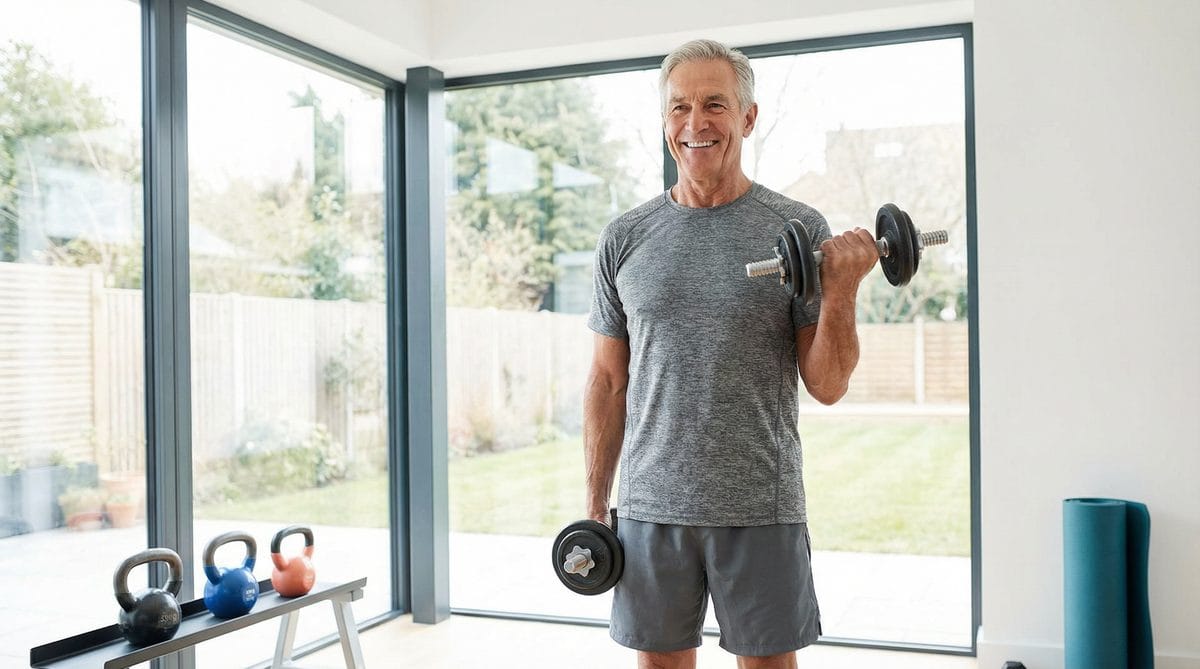
Strength training after 60 can begin with manageable movements that relate to daily life. Focus on technique, appropriate effort and recovery rather than heavy weights or a promise that one routine is safe for everyone.
The evidence and the problem
Public-health guidance includes muscle-strengthening activity, and the Canadian 65+ movement guidelines place it alongside aerobic activity and balance. These are broad recommendations, not individualized exercise clearance.
A beginner plan can fail if it assumes everyone has the same joints, balance, equipment or recovery. A clinician or physiotherapist can help match the starting point to the person.
Five foundational movement patterns for everyday strength
Choose a stable setup and a comfortable range. Age alone does not determine the right variation. Start light enough to move smoothly and breathe throughout; joint pain is a reason to change the exercise, not push through it.
Sit down and stand up
Start: rise from a firm, higher chair; use armrests if needed.
Build: gradually reduce assistance or add a light held weight.
Daily use: getting out of a chair or car.
Move from the hips
Start: practise pushing your hips back toward a wall, keeping the movement small.
Build: lift a light object from a raised surface with suitable instruction.
Daily use: picking up a bag.
Press away
Start: a standing wall push-up.
Build: use a lower, fixed support only when comfortable.
Daily use: pushing a door or rising with arm support.
Draw toward you
Start: a light resistance-band row with a manufacturer-approved secure anchor.
Build: add resistance while keeping the shoulders comfortable.
Daily use: pulling a door or bringing objects closer.
Hold and move
Start: hold two light loads while standing beside stable support.
Build: take short steps on an uncluttered route if balance allows.
Daily use: carrying groceries.
For a first session, try one easy set of a few controlled repetitions, leaving several repetitions in reserve. A physiotherapist or qualified exercise professional can adapt the patterns for osteoporosis, recent surgery, painful joints or balance limitations. Build toward regular strength work as appropriate; no variation is guaranteed pain-free.
CDC guidance includes muscle-strengthening activity. The variations above are adaptable examples, not a rehabilitation prescription.
Common mistakes and mindset guardrails
- Copying a fixed weight or repetition target.
- Holding your breath or rushing to finish. Ask for technique guidance.
- Training through sharp pain, dizziness or unexplained weakness.
Do not push through warning symptoms. Stop activity and seek help for new or unexplained symptoms. For possible heart-attack or stroke symptoms, fainting or severe breathing difficulty, call 911 or your local emergency number. A comfortable pace or watch reading does not guarantee safety.
Primary care discussion checklist
Use the questions that fit your situation. Keep personal health notes private and bring them through your clinic’s approved channel.
- Which movements should I adapt because of joint, bone or balance concerns?
- What starting workload and recovery interval are appropriate?
- Would supervised instruction or physiotherapy be useful?
Next steps and related reading
Choose one useful next step rather than adding several new tasks at once.
Educational guidance. Not medical advice.
Daily Movement After 45: A Flexible Exercise Framework
Continue with a focused guide, then keep the questions relevant to your situation.
VO2 Max After 45: What Cardiorespiratory Fitness Can Tell You About Healthy Aging
Continue with a focused guide, then keep the questions relevant to your situation.
Sleep After 45: Better Rest, Recovery & Longevity
Continue with a focused guide, then keep the questions relevant to your situation.
Evidence & Primary Sources
Original references and further reading are retained below. These include research and educational resources; inclusion is not a study-level appraisal or endorsement. See our evidence and editorial policy.
Authorship and editorial disclosures. This editorial update does not claim a new independent medical review. Report a correction.
More in Movement · All Guides
FREE LONGEVITY STARTER KIT
Choose one useful next step.
A six-health-numbers checklist and a weekly habit planner, ready to use without signing up.
Email delivery is optional and includes occasional Fruitful Years emails. Unsubscribe anytime.