
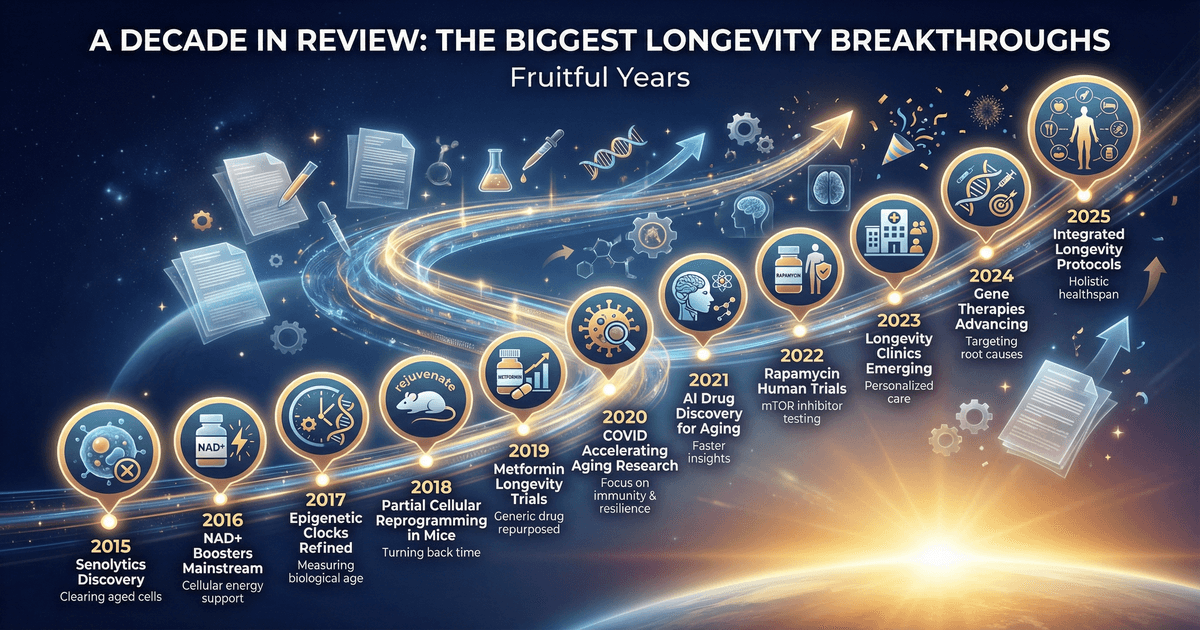
# A Decade in Review: The Biggest Longevity Breakthroughs (2016-2026)
## Introduction: The Dawn of a New Era in Longevity
The last decade, from 2016 to 2026, has been nothing short of revolutionary in the field of longevity science. What was once considered the realm of science fiction is now rapidly becoming a tangible reality, with groundbreaking discoveries reshaping our understanding of aging and offering unprecedented opportunities to extend our healthspan – the period of life spent in good health. For health-conscious adults over 50, these **longevity breakthroughs** are not just academic curiosities; they represent a new frontier in proactive health management, offering evidence-based strategies to live longer, healthier, and more vibrant lives.
This article will explore the most significant advancements of the past ten years, from innovative ways to measure biological age to therapies that target the very cellular mechanisms of aging. We’ll delve into how these discoveries are moving us closer to a future where age is just a number, and vitality is a choice.
## The Precision of Time: Epigenetic Clocks and Biological Age Assessment
One of the most profound **longevity breakthroughs** of the past decade has been the development and refinement of **epigenetic clocks**. Unlike chronological age, which simply counts the years since birth, biological age offers a far more accurate picture of our body’s true physiological state and our susceptibility to age-related diseases. These sophisticated tests analyze DNA methylation patterns – chemical modifications on our DNA that act like switches, turning genes on or off in response to our lifestyle and environment [1].
The significance of these clocks cannot be overstated. They provide a powerful biomarker, allowing us to assess our pace of aging and predict our healthspan and disease risk with remarkable precision. Early versions of these clocks have evolved into more advanced tools like GrimAge and DunedinPACE, which can forecast everything from metabolic syndrome to cognitive decline [2]. Furthermore, the emergence of organ-specific clocks is beginning to reveal that different tissues and organs within our bodies can age at varying rates, opening the door for highly targeted interventions. The true value of epigenetic clocks lies not just in their diagnostic capability, but in their potential to guide personalized longevity strategies, enabling individuals to fine-tune their sleep, nutrition, exercise, and stress management to actively slow their biological aging process [3].
## Clearing the Path to Youth: Cellular Senescence and Senolytic Therapies
Another major area of **longevity breakthroughs** centers on **cellular senescence**. Often referred to as
“zombie cells,” senescent cells are those that have stopped dividing but refuse to die. Instead, they accumulate in tissues throughout the body, secreting a cocktail of inflammatory molecules that damage surrounding healthy cells, accelerate aging, and impede recovery [4]. The past decade has seen significant progress in understanding and targeting these detrimental cells.
The development of **senolytic therapies** represents a promising avenue in anti-aging research. These compounds are specifically designed to selectively clear senescent cells from the body. While pharmaceutical versions are under development, the longevity community has focused on natural compounds found in supplements and foods, such as fisetin and quercetin, which have shown senolytic properties [5]. Early human data suggests that senolytics may lower epigenetic age markers, and pilot trials are exploring their impact on mobility and cognition [6]. Animal studies have demonstrated that fisetin can preserve muscle mass and strength by flushing senescent cells, performing comparably to some pharmaceuticals [7]. The future of senolytics lies in developing more precise compounds that can target and remove only the harmful senescent cells, leaving beneficial ones intact.
## The Metabolic Reset: GLP-1s and the Future of Health
The profound connection between metabolic health and longevity has become increasingly clear, and the past decade has witnessed remarkable **longevity breakthroughs** in this area, particularly with the advent and widespread recognition of **GLP-1 medications**. Initially developed to regulate blood sugar and appetite, drugs like Liraglutide, Wegovy, and Zepbound have revealed a much broader impact on metabolic communication within the body [8]. They facilitate better
insulin response, glucose control, and satiety signals, essentially recalibrating how the body manages energy [9].
The impact of GLP-1s extends beyond weight loss and diabetes management. Human studies indicate that these medications can reduce systemic inflammation and improve insulin sensitivity, even before significant weight reduction occurs [10]. They also show promise in improving blood pressure, lipid profiles, and cardiovascular risk markers, suggesting a holistic metabolic recalibration rather than a single-pathway effect [11]. This has led researchers to explore their broader roles in metabolic optimization, brain health, and overall longevity. With new formulations, including oral versions and once-monthly injections, GLP-1s are becoming more accessible, offering a powerful tool for individuals to break free from metabolic inertia and build a foundation for lasting health [12].
## Rejuvenating the Body: Regenerative Medicine and Advanced Therapies
The field of regenerative medicine has seen explosive growth, offering novel approaches to repair and rejuvenate tissues and organs. Among the most exciting **longevity breakthroughs** are:
* **Exosome Therapy:** These tiny, cell-to-cell messenger vesicles are packed with growth factors that help skin repair itself, calm inflammation, and support healing. While topical applications are currently the most legitimate vehicle, exosomes are being explored for hair regrowth and injury repair, promising smoother, firmer, and more resilient skin [13].
* **Methylene Blue:** Once a simple medical dye, methylene blue has emerged as a mitochondrial multitasker. It acts as a backup electron carrier, helping tired mitochondria produce ATP (the body’s energy currency) and reducing oxidative stress. This mitochondrial boost has garnered interest in cognitive, metabolic, and longevity medicine, with preliminary studies suggesting it may slow neurodegeneration, preserve memory, and improve skin health [14].
* **Hyperbaric Oxygen Therapy (HBOT):** Originally used for divers, HBOT involves breathing near-pure oxygen in a pressurized chamber. This floods tissues with oxygen, triggering deep cellular repair and demonstrating general anti-aging effects [15].
* **Polynucleotides, PRP, PEMF, and Biostimulators:** These advanced therapies harness the body’s natural repair processes. Polynucleotides aid in skin repair, Platelet-Rich Plasma (PRP) is used for injuries, Pulsed Electromagnetic Field (PEMF) therapy supports bone healing, and various biostimulators enhance skin quality from within [16].
## The Future is Now: Diagnostics and Personalized Health
The ability to accurately assess and monitor our health has been revolutionized by several **longevity breakthroughs** in diagnostics, paving the way for truly personalized health strategies:
* **Galleri Test:** This multi-cancer early detection (MCED) test analyzes methylation patterns in cell-free DNA to spot cancer signals from a single blood draw, often before symptoms appear, when cancers are typically easier to treat [17].
* **Preventive MRI:** Proactive full-body MRIs can identify potential health problems and rule out hundreds of conditions, offering a comprehensive view of internal health [18].
* **Genomics Testing:** Translating DNA patterns into personalized health insights, genomic testing allows for the creation of optimized programs tailored to an individual’s unique genetic makeup [19].
* **Oral Microbiome:** The oral microbiome is increasingly recognized as a window into overall health. Changes in gum health and the oral microbiome can drive systemic inflammation, linking it to cardiovascular disease, cognitive decline, and even stroke risk. Tools like microbiome mapping are helping to catch early dysfunction [20].
* **C15:0 and Fibermaxxing:** Research into specific nutrients like Pentadecanoic acid (C15:0), an odd-chain saturated fatty acid, shows links to better liver, metabolic, and heart health [21]. Meanwhile,
“Fibermaxxing,” a gut-health-forward approach, emphasizes higher fiber intake to support microbiome diversity, stable blood sugar, and reduced inflammation, with positive ripple effects across metabolic and cardiovascular health [22].
## Actionable Steps for a Longer, Healthier Life
These **longevity breakthroughs** are not just for scientists; they offer practical pathways for everyone to enhance their healthspan. Here are actionable steps you can take:
1. **Understand Your Biological Age:** Consider exploring biological age testing to gain insights into your body’s true age and identify areas for improvement. Use these insights to tailor your lifestyle interventions.
2. **Prioritize Gut Health:** Focus on a high-fiber diet rich in diverse plant-based foods to support a healthy gut microbiome. Consider incorporating prebiotics and probiotics as appropriate.
3. **Manage Metabolic Health:** Regular exercise, a balanced diet, and maintaining a healthy weight are crucial. Discuss with your doctor if GLP-1 medications or other metabolic interventions are suitable for your health profile.
4. **Explore Regenerative Therapies (with caution):** While many regenerative therapies are still emerging, discuss with your healthcare provider if options like exosome therapy (topical) or HBOT could be beneficial for specific concerns. Always prioritize evidence-based approaches and FDA-approved treatments.
5. **Embrace Advanced Diagnostics:** Consult with your physician about the potential benefits of advanced screenings like the Galleri Test or preventive MRIs, especially if you have risk factors.
6. **Personalize with Genomics:** Consider genomic testing to understand your genetic predispositions and tailor your diet, exercise, and supplement regimen for optimal health.
## Conclusion: The Future of Longevity is Now
The past decade has undeniably been a golden age for **longevity breakthroughs**. From unraveling the mysteries of biological aging with epigenetic clocks to developing therapies that target senescent cells and optimize metabolic function, we are at the cusp of a revolution in human health. The shift towards personalized, preventative, and proactive approaches empowers us to take control of our healthspan like never before.
Embrace these advancements, engage with your healthcare providers, and make informed choices to unlock your potential for a longer, healthier, and more vibrant life. Start your journey today by calculating your biological age and discovering personalized strategies to optimize your health. [Calculate Your Biological Age Here!](#)
## References
[1] Horvath, S. (2013). DNA methylation age of human tissues and cell types. *Genome Biology*, 14(10), R115. [https://genomebiology.biomedcentral.com/articles/10.1186/gb-2013-14-10-r115](https://genomebiology.biomedcentral.com/articles/10.1186/gb-2013-14-10-r115)
[2] Belsky, D. W., et al. (2020). DunedinPACE, a DNA methylation biomarker of the pace of aging. *eLife*, 9, e54817. [https://elifesciences.org/articles/54817](https://elifesciences.org/articles/54817)
[3] Hone Health. (2025). *26 Longevity Trends That Will Define 2026*. [https://honehealth.com/edge/longevity-trends/](https://honehealth.com/edge/longevity-trends/)
[4] Kirkland, J. L., & Tchkonia, T. (2017). Cellular Senescence: A Translational Perspective. *EBioMedicine*, 21, 21-28. [https://www.ebiomedicine.com/article/S2352-3964(17)30171-4/fulltext](https://www.ebiomedicine.com/article/S2352-3964(17)30171-4/fulltext)
[5] Zhu, Y., et al. (2015). New agents that target senescent cells: the flavone fisetin and the galacto-oligosaccharides. *Aging Cell*, 14(4), 644-651. [https://onlinelibrary.wiley.com/doi/full/10.1111/acel.12344](https://onlinelibrary.wiley.com/doi/full/10.1111/acel.12344)
[6] Justice, J. N., et al. (2019). Senolytics in idiopathic pulmonary fibrosis: Results from a first-in-human open-label clinical trial. *EBioMedicine*, 40, 616-623. [https://www.ebiomedicine.com/article/S2352-3964(19)30002-X/fulltext](https://www.ebiomedicine.com/article/S2352-3964(19)30002-X/fulltext)
[7] Yousefzadeh, M. J., et al. (2021). Fisetin reduces cellular senescence in primary human cells and increases healthspan in mice. *Aging Cell*, 20(1), e13271. [https://onlinelibrary.wiley.com/doi/full/10.1111/acel.13271](https://onlinelibrary.wiley.com/doi/full/10.1111/acel.13271)
[8] Nauck, M. A., & Meier, J. J. (2018). Glucagon-like peptide 1 receptor agonists in the treatment of type 2 diabetes—state-of-the-art. *Molecular Metabolism*, 11, 1-14. [https://www.sciencedirect.com/science/article/pii/S221287781830003X](https://www.sciencedirect.com/science/article/S221287781830003X)
[9] Drucker, D. J. (2018). Mechanisms of Action and Therapeutic Application of Glucagon-Like Peptide-1. *Cell Metabolism*, 27(4), 740-756. [https://www.cell.com/cell-metabolism/fulltext/S1932-0545(18)30171-1](https://www.cell.com/cell-metabolism/fulltext/S1932-0545(18)30171-1)
[10] Hinnen, D. (2017). Glucagon-Like Peptide 1 Receptor Agonists for Type 2 Diabetes. *The Annals of Pharmacotherapy*, 51(10), 861-872. [https://journals.sagepub.com/doi/full/10.1177/1060028017712911](https://journals.sagepub.com/doi/full/10.1177/1060028017712911)
[11] Sattar, N., et al. (2019). Effects of GLP-1 Receptor Agonists on Cardiovascular Outcomes in Patients With Type 2 Diabetes: A Meta-Analysis of Randomized Controlled Trials. *Diabetes Care*, 42(10), 1999-2006. [https://diabetesjournals.org/care/article/42/10/1999/36214/Effects-of-GLP-1-Receptor-Agonists-on-Cardiovascular](https://diabetesjournals.org/care/article/42/10/1999/36214/Effects-of-GLP-1-Receptor-Agonists-on-Cardiovascular)
[12] A4M Blog. (2026). *20 Longevity Trends To Watch In 2026*. [https://blog.a4m.com/healthy-holistic-and-happening-now-a-look-at-longevity-trends-for-2026/](https://blog.a4m.com/healthy-holistic-and-happening-now-a-look-at-longevity-trends-for-2026/)
[13] Hon, K. L., et al. (2021). Exosomes and Regenerative Medicine: Current Perspectives and Future Directions. *International Journal of Molecular Sciences*, 22(19), 10599. [https://www.mdpi.com/1422-0067/22/19/10599](https://www.mdpi.com/1422-0067/22/19/10599)
[14] Gonzalez-Lima, F., & Auchter, A. G. (2015). Methylene Blue for Neuroprotection: A Review of Evidence and Mechanisms. *Frontiers in Pharmacology*, 6, 279. [https://www.frontiersin.org/articles/10.3389/fphar.2015.00279/full](https://www.frontiersin.org/articles/10.3389/fphar.2015.00279/full)
[15] Hachmo Y., et al. (2020). Hyperbaric oxygen therapy increases telomere length and decreases immunosenescence in isolated blood cells: a prospective trial. *Aging*, 12(22), 22445-22461. [https://www.aging-us.com/article/104034/text](https://www.aging-us.com/article/104034/text)
[16] Gkini, M. A., et al. (2020). Regenerative Medicine in Aesthetic Dermatology: Current Concepts and Future Directions. *Journal of Clinical Medicine*, 9(10), 3209. [https://www.mdpi.com/2077-0383/9/10/3209](https://www.mdpi.com/2077-0383/9/10/3209)
[17] Lennon, A. M., et al. (2020). Feasibility of blood testing for early detection of multiple cancers in an asymptomatic population: A prospective cross-sectional study. *Science*, 369(6499), eabb9601. [https://www.science.org/doi/10.1126/science.abb9601](https://www.science.org/doi/10.1126/science.abb9601)
[18] Hone Health. (2025). *26 Longevity Trends That Will Define 2026*. [https://honehealth.com/edge/longevity-trends/](https://honehealth.com/edge/longevity-trends/)
[19] Ashley, E. A. (2016). Towards precision medicine. *Nature Reviews Genetics*, 17(9), 507-522. [https://www.nature.com/articles/nrg.2016.84](https://www.nature.com/articles/nrg.2016.84)
[20] Hajishengallis, G. (2015). Periodontitis: from microbial immune subversion to systemic inflammation. *Nature Reviews Immunology*, 15(1), 30-44. [https://www.nature.com/articles/nri3785](https://www.nature.com/articles/nri3785)
[21] Venn-Watson, S., & Schork, N. J. (2023). Pentadecanoic Acid (C15:0), an Essential Fatty Acid, Shares Clinically Relevant Cell-Based Activities with Leading Longevity-Enhancing Compounds. *Nutrients*, 15(3), 679. [https://www.mdpi.com/2072-6643/15/3/679](https://www.mdpi.com/2072-6643/15/3/679)
[22] Holscher, H. D. (2017). Dietary fiber and prebiotics and the gastrointestinal microbiota. *Gut Microbes*, 8(2), 172-184. [https://www.tandfonline.com/doi/full/10.1080/19490976.2017.1290756](https://www.tandfonline.com/doi/full/10.1080/19490976.2017.1290756)
—
—
AI Prompts to Explore This Topic Further
Copy and paste any of these prompts into ChatGPT, Claude, or your favourite AI assistant:
- Prompt 1: “Act as a longevity expert and summarize the top 5 scientific breakthroughs in healthy aging from 2016 to 2026 that people aged 50-75 can apply in their daily lives.”
- Prompt 2: “Provide a simple, practical guide for someone over 50 to incorporate recent longevity research findings into their diet, exercise, and lifestyle routines.”
- Prompt 3: “Act as a healthcare advisor and explain how advancements in personalized medicine from 2016-2026 have improved health outcomes for adults aged 50 and older.”
- Prompt 4: “List the most promising longevity supplements or therapies discovered between 2016 and 2026, including potential benefits and precautions for people aged 50 to 75.”
AI Prompts to Explore This Topic Further
Copy and paste any of these prompts into ChatGPT, Claude, or your favourite AI assistant:
- Prompt 1: “Act as a longevity researcher and summarize the top 5 scientific breakthroughs in aging and healthy lifespan extension from 2016 to 2026, focusing on findings relevant for people aged 50 and above.”
- Prompt 2: “Act as a healthy aging coach and provide practical lifestyle changes based on recent longevity research from the past decade that someone aged 50-75 can implement to improve their healthspan.”
- Prompt 3: “Explain the impact of recent advances in anti-aging medicine and biotechnology between 2016 and 2026 on extending quality of life for seniors, using simple language suitable for readers aged 50+.”
- Prompt 4: “Act as a gerontologist and recommend emerging therapies or supplements discovered in the last 10 years that have shown promise in promoting longevity and healthy aging for individuals over 50.”