Medical Disclaimer
This article is for general informational purposes only and does not constitute medical advice. Consult a qualified healthcare professional before making major changes to your exercise routine, particularly if you have cardiovascular, respiratory, metabolic, neurological or mobility concerns.
Want a broader starting point? Use the free 6 Health Numbers Checklist to organize the basics and prepare better questions for your clinician.
VO2 max estimates how much oxygen your body can use during very hard exercise. It is one of the clearest measures of cardiorespiratory fitness—the combined ability of your heart, lungs, blood vessels and working muscles to support sustained activity.
After 45, VO2 max can be useful because it reflects functional capacity and often responds to training. It is also strongly associated with long-term health outcomes. But it is not a biological-age verdict, and a wearable estimate is not a diagnosis. The practical goal is to improve your fitness safely and preserve the capacity to walk hills, climb stairs, travel and stay independent.
Key Takeaways
- VO2 max is a useful fitness marker, not a complete measure of health or longevity.
- Laboratory cardiopulmonary exercise testing is the reference method; field tests and wearables are estimates.
- Consistent moderate aerobic work builds the base. Carefully introduced higher-intensity intervals can provide an additional stimulus.
- Your trend, daily function and training consistency usually matter more than comparing one number with someone else.
- Adults with symptoms, major medical conditions or a long period of inactivity should discuss vigorous exercise or maximal testing with a clinician first.
What VO2 Max Measures
VO2 max is usually expressed as millilitres of oxygen used per kilogram of body weight per minute (mL/kg/min). A higher value generally means your body can deliver and use more oxygen during intense effort. Laboratories may report VO2 peak when a true physiological maximum cannot be confirmed.
The number is influenced by age, sex, genetics, training status, body composition, testing method, altitude, illness, medication and effort. Because relative VO2 max divides oxygen use by body weight, weight changes can alter the score even if your underlying aerobic machinery changes less. That is one reason not to treat the number in isolation.
Why It Matters After 45
Large observational studies consistently find that higher cardiorespiratory fitness is associated with lower all-cause mortality. For example, a cohort of more than 122,000 adults undergoing treadmill testing found a graded inverse association between fitness and long-term mortality. This is important evidence, but it does not prove that raising one measured number directly causes every observed benefit. Fitness also travels with activity, health status and other factors.
The more immediate value is functional. Better aerobic capacity can make ordinary demands feel easier and provide more reserve during illness, travel or recovery. VO2 max also complements—not replaces—blood pressure, cholesterol, glucose, strength, balance, sleep and other factors covered in a personal longevity protocol.
What Is a Good VO2 Max?
There is no single ideal score for everyone over 45. Reference ranges vary by age, sex, protocol and population. A laboratory can interpret your result against an appropriate reference set, while a wearable may use its own categories and algorithm.
A practical interpretation uses three questions:
- Function: Can you handle the activities that matter to you without unusual breathlessness or fatigue?
- Trend: Is your estimate stable or improving when measured under similar conditions?
- Context: Do symptoms, medications or health conditions make the score unreliable or change what training is appropriate?
A modest score that improves safely can be more useful than an “excellent” label obtained from an inconsistent device. Avoid chasing a population percentile at the expense of recovery, strength or enjoyment.
How VO2 Max Is Tested
| Method | Best use | Main limitation |
|---|---|---|
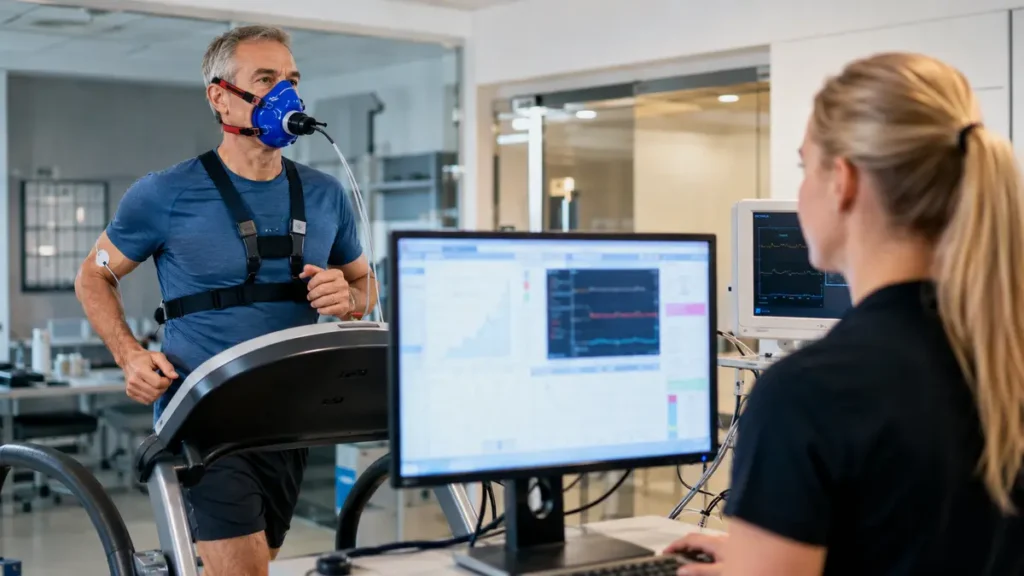
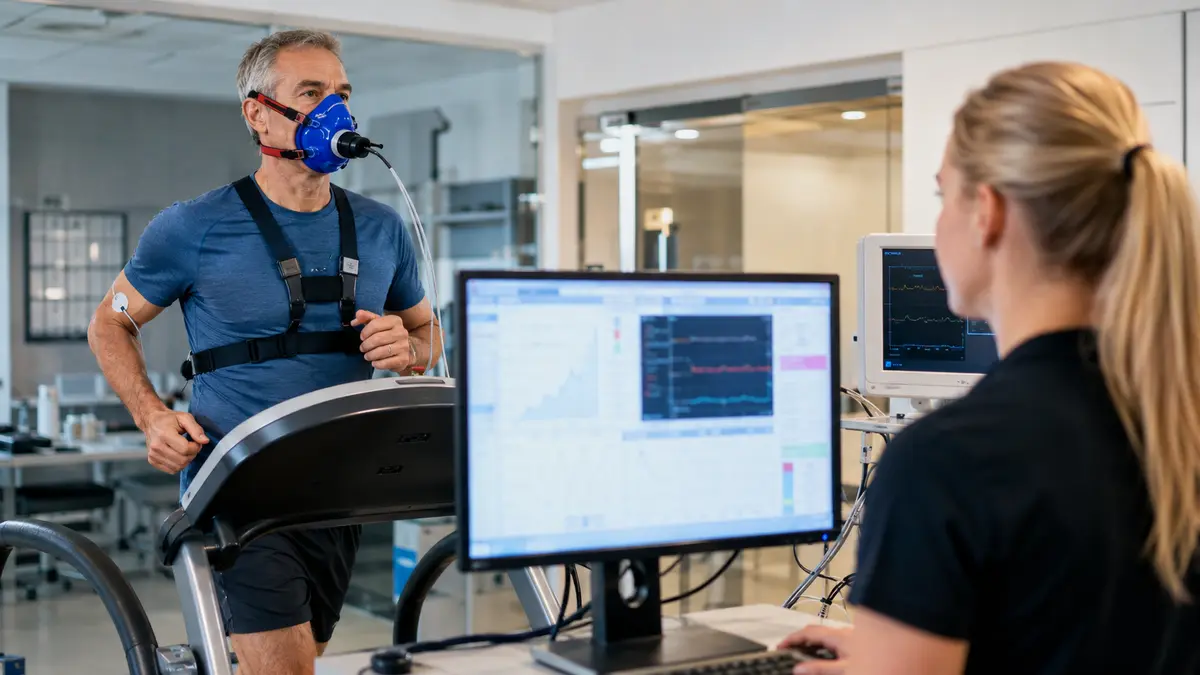
| Laboratory cardiopulmonary exercise test | Most precise assessment; can measure oxygen and carbon-dioxide exchange during a graded treadmill or cycle test | Cost, access and maximal effort; may require clinical supervision |
| Supervised submaximal test | Estimating fitness without requiring an all-out effort | Result depends on prediction equations, heart-rate response and protocol |
| Field test | Low-cost repeatable tracking, such as a validated walk test administered consistently | Weather, terrain, pacing, mobility and motivation affect results |
| Wearable estimate | Convenient long-term trend during supported activities | Not a direct measurement; accuracy varies by device, user and activity |
Maximal running tests are not the right starting point for every adult. A brisk walking test or supervised submaximal assessment may be safer and more repeatable for beginners. Consumer watches can be useful for trends, but validation studies show meaningful individual error. Compare readings from the same device, under similar conditions, rather than treating the displayed value as a clinical measurement.
The Training Approach That Usually Works
The foundation is regular aerobic activity at an intensity you can recover from. Canada’s movement guidance recommends at least 150 minutes of moderate-to-vigorous aerobic activity per week for adults, plus muscle-strengthening work at least twice weekly. That is a health target, not a requirement to begin at full volume.
1. Build the aerobic base
Walking briskly, cycling, swimming, rowing or using an elliptical can all work. At moderate intensity, your breathing is clearly elevated but you can still speak in short sentences. If you are starting from a low baseline, even 10–20 minutes at a comfortable pace can be productive.
2. Add intensity gradually
Intervals can improve cardiorespiratory fitness, but “high intensity” should be relative to your current capacity. It does not have to mean sprinting. After you have established a base—and when vigorous exercise is appropriate—short controlled efforts on a bike, hill or brisk walk can provide a stronger stimulus with less impact than all-out running.
3. Keep strength and recovery in the plan
Aerobic fitness is only one part of healthy aging. Two weekly sessions from a sensible strength-training plan support muscle, bone and daily function. Adequate recovery, nutrition and sleep help you train consistently.
A Conservative Four-Week Starter Plan
This example is for generally healthy adults who can already walk comfortably and have no warning symptoms. Choose low-impact modes if joints or balance are concerns. Keep at least one easy or rest day between harder sessions.
| Week | Aerobic sessions | Optional controlled intervals | Strength |
|---|---|---|---|
| 1 | 3 sessions of 20–25 minutes at easy-to-moderate effort | None; establish consistency | 2 light full-body sessions |
| 2 | 3 sessions of 25–30 minutes | During one session: 4 × 30 seconds brisk, with 90 seconds easy | 2 sessions |
| 3 | 3 sessions of 30 minutes | During one session: 5 × 45 seconds brisk, with 90 seconds easy | 2 sessions |
| 4 | 3 sessions of 30–35 minutes | During one session: 5 × 1 minute strong but controlled, with 2 minutes easy | 2 sessions |
The interval effort should leave you working hard but still in control—not gasping, sprinting or straining. If recovery, sleep, joint comfort or motivation deteriorates, reduce intensity or repeat the previous week. Progress one variable at a time: duration, frequency or intensity.
After four weeks, reassess how daily activities feel and review a consistent wearable or field-test trend if you use one. Meaningful physiological change often takes longer than a month, so the first checkpoint is mainly about tolerance and adherence.
When to Seek Guidance Before Pushing Harder
Discuss vigorous exercise or maximal testing with a clinician or qualified exercise professional if you have known heart, lung, metabolic or neurological disease; unexplained fainting; major mobility limitations; or a long period of inactivity combined with risk factors. Medications such as beta blockers can change heart-rate response, making generic target-heart-rate formulas less useful.
Stop exercise and seek urgent assessment for chest pressure or pain, fainting, severe or unusual shortness of breath, or symptoms suggesting a medical emergency. New palpitations, dizziness or a sharp decline in exercise tolerance also warrant professional review.
Common Mistakes
- Chasing the watch score: A device estimate can move because of heat, terrain, fatigue, sensor fit or algorithm changes.
- Starting with all-out intervals: More intensity is not automatically more benefit, especially before a base is established.
- Using age-predicted heart rate as a precise prescription: Formulas describe averages and can be distorted by medications and individual variation.
- Ignoring strength and recovery: A higher aerobic score does not protect every aspect of function.
- Testing too often: Daily fluctuations create noise. Review longer trends under comparable conditions.
Frequently Asked Questions
Can VO2 max improve after 60?
Yes. Older adults can improve cardiorespiratory fitness through consistent training, although the size and speed of change vary. Starting level, health conditions, program design, recovery and adherence all matter.
Is walking enough?
Walking can improve fitness, especially for someone who has been inactive. As fitness rises, a flat easy walk may no longer provide enough stimulus. Increasing pace, duration, incline or adding controlled intervals can help while keeping the activity accessible.
How quickly should the number change?
Some people see a change within several weeks; others need months, and some wearables may not show a reliable change at all. Look for improved pace at the same effort, easier hills, better recovery and greater consistency—not only a device score.
Is VO2 max the best predictor of longevity?
Cardiorespiratory fitness is one of the strongest health markers observed in population studies, but calling it the single best predictor is too absolute. It should be interpreted alongside medical history, blood pressure, metabolic health, strength, smoking, sleep and social factors.
Practical Bottom Line
VO2 max is valuable because it turns aerobic capacity into a trackable signal. Its best use after 45 is not to predict a personal expiration date. It is to guide a sustainable program that preserves reserve and makes daily life easier.
Build a base, add intensity only when appropriate, combine aerobic work with strength training, and judge progress by both function and a consistent trend. For a broader framework, see Zone 2 Cardio and Longevity and the advanced biomarker guide.
Useful Next Steps
To turn VO2 max into a sustainable plan, pair this article with Zone 2 Cardio After 45, Strength Training After 60, and Sleep After 45.
Sources
- Canadian Society for Exercise Physiology: Canadian 24-Hour Movement Guidelines
- American Heart Association: Physical Activity Recommendations for Adults
- Mandsager et al.: Cardiorespiratory Fitness and Long-term Mortality
- Passler et al.: Validity of Wrist-Worn Trackers for Estimating VO2 Max
- HealthLink BC: Chest Problems and Warning Symptoms