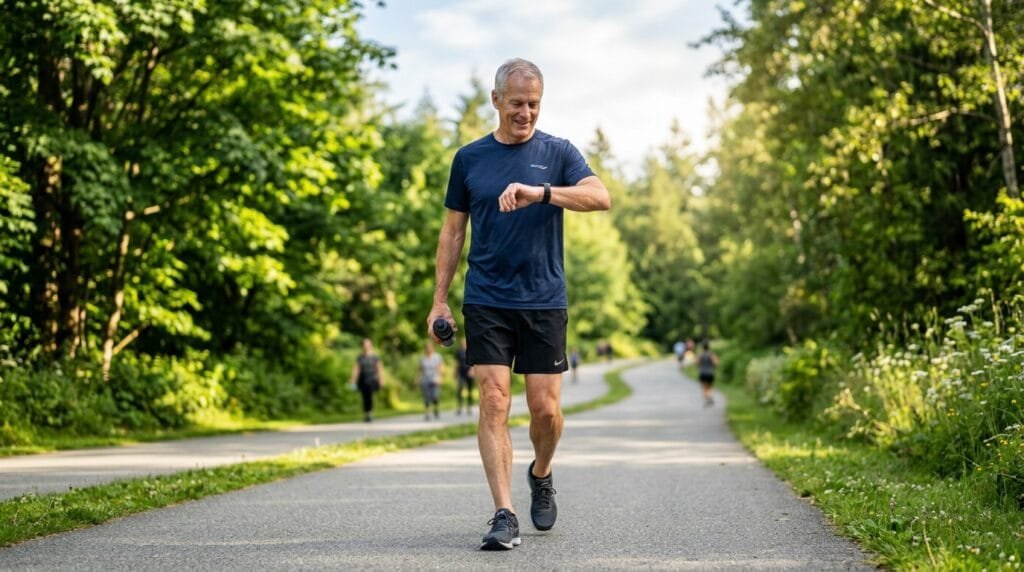
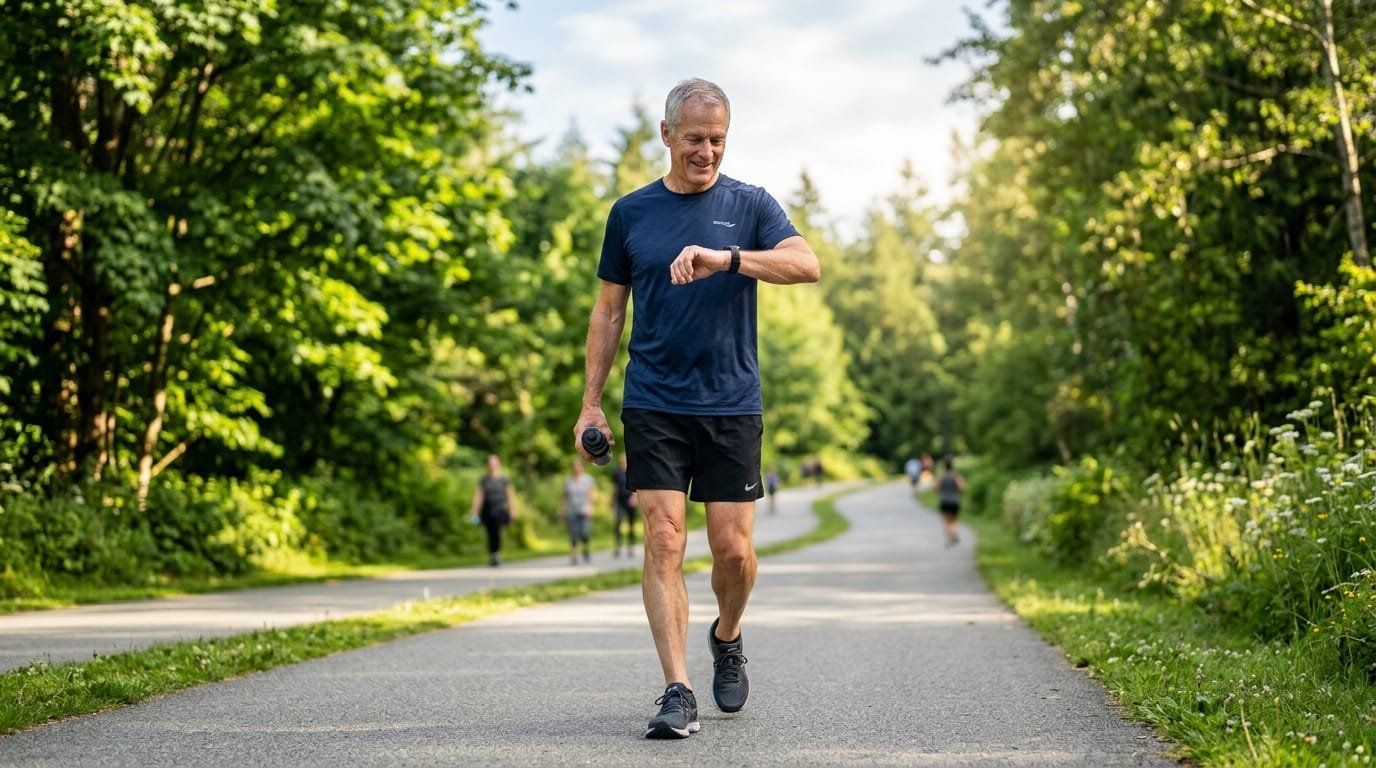
Key Takeaways & Protocol Summary
- Formulas Provide Estimates, Not Diagnostic Boundaries: Age-based equations carry wide individual error. Tanaka and colleagues (2001) found standard deviations of roughly 10 to 12 beats per minute (bpm), meaning population formulas frequently miss an individual’s true threshold.
- MAF and Karvonen Offer Different Starting Points: The MAF 180 heuristic provides a conservative, low-fatigue ceiling, while the Karvonen calculation factors in resting heart rate to establish a target aerobic band.
- The Talk Test Is Your Practical Arbiter: If speaking in full, comfortable sentences becomes difficult, your intensity has drifted above easy aerobic effort—regardless of what your watch displays.
- Medication Notice: Beta-blockers and other blood pressure medications alter your heart rate response. If taking these medications, rely on conversational breathing, perceived effort, or clinician-guided testing rather than standard formulas.
When building an aerobic base after 60, a reasonable intensity estimate helps you avoid turning every session into an exhausting workout while ensuring you apply enough stimulus to support cardiorespiratory health.
While our Core Guide to Zone 2 Cardio for Longevity explores cellular adaptations and weekly schedules, this practical guide covers the numbers: how to estimate your target range, why popular formulas disagree, and how to verify your effort during daily exercise.
What Does “Zone 2” Mean Here?
“Zone 2” is not defined identically across exercise physiology labs, coaching frameworks, and wearable devices. In this guide, we use the term broadly to describe sustainable, low-to-moderate aerobic exercise below the first ventilatory threshold (often approximated, but not always identical to, the first lactate threshold). Heart rate formulas provide starting estimates, but they cannot measure these metabolic thresholds directly.
The Problem with Standard Age-Based Formulas
Most gym equipment and default smartwatch profiles still rely on the traditional Fox-Haskell equation:
Max Heart Rate = 220 − Age
For a 65-year-old, this predicts a maximum heart rate of 155 bpm, placing a generic 60%–70% aerobic window between 93 and 109 bpm.
However, actual maximum heart rate varies substantially among individuals of identical age. For someone with a naturally higher maximum heart rate of 170 bpm, exercising at 95 bpm feels like a casual stroll. For an individual with a true maximum of 142 bpm, 108 bpm may already induce heavy breathing.
To establish a practical starting range without undergoing a treadmill lactate test, two estimation models are commonly used: The MAF 180 Heuristic and The Karvonen (Heart Rate Reserve) Formula.
Method 1: The MAF 180 Heuristic
Developed by coach Dr. Phil Maffetone, the Maximum Aerobic Function (MAF) formula is a popular coaching heuristic designed to establish a conservative ceiling for low-intensity aerobic training.
The Calculation
Aerobic Ceiling = 180 − Age
Maffetone’s Historical Category Adjustments:
- Subtract 10: If recovering from major illness, surgery, or dealing with chronic health conditions.
- Subtract 5: If you are a beginner, exercise inconsistently, or experience frequent colds.
- No adjustment (180 − Age): If you have trained consistently (at least 4 times weekly) for the past 2 years without major setbacks.
Worked Example: 65-Year-Old Active Adult
- Baseline Calculation: 180 − 65 = 115 bpm
- Practical Training Bracket: 105 to 115 bpm (Many practitioners use the 10 bpm band immediately below the ceiling as their workout range).
Practical Limitation: MAF 180 is a coaching heuristic rather than an established clinical measurement. For adults over 65, age-based formulas become less representative of an individual’s actual physiological response. Treat it as a conservative starting ceiling—not a guarantee of safety or a strict biological rule.
Method 2: The Karvonen (Heart Rate Reserve) Formula
The Karvonen Method factors in your Resting Heart Rate (RHR), reflecting the reality that resting pulse influences your functional heart rate reserve.
Step 1: Estimate Max HR (Tanaka Equation)
Estimated Max HR = 208 − (0.7 × Age)
Step 2: Calculate Heart Rate Reserve (HRR)
HRR = Estimated Max HR − Resting HR
Step 3: Calculate an Aerobic Training Range
Standard exercise guidelines place moderate aerobic intensity at 40% to 59% of HRR, while many fitness programs use 60% to 70% of HRR as a higher aerobic training bracket:
Target Heart Rate = Resting HR + (HRR × Intensity Percentage)
Step-by-Step Worked Example: 68-Year-Old Adult
- Age: 68
- Resting Heart Rate: 58 bpm (measured upon waking)
- Estimated Max HR: 208 − (0.7 × 68) = 160.4 (rounded to 160 bpm)
- Heart Rate Reserve (HRR): 160 − 58 = 102 bpm
Higher Aerobic Bracket (60%–70% HRR):
- Lower Estimate (60%): 58 + (102 × 0.60) = 58 + 61.2 = 119 bpm
- Upper Estimate (70%): 58 + (102 × 0.70) = 58 + 71.4 = 129 bpm
- Calculated Window: 119 to 129 bpm
(Note: For a moderate-intensity baseline using 40%–59% HRR, this same individual would calculate to roughly 99 to 118 bpm).
Why the Formulas Disagree: Comparing the Numbers
For the same 68-year-old, MAF suggests a ceiling of 112 bpm, while a 60%–70% Karvonen bracket yields 119 to 129 bpm.
They disagree because they use different premises:
- MAF 180 prioritizes a simple, conservative age-based ceiling.
- Karvonen converts a selected percentage of estimated reserve into a target, scaling with resting pulse and the chosen intensity percentage.
The table below illustrates these differences across age groups (assuming an average resting heart rate of 62 bpm, using Tanaka Max HR, rounded to the nearest whole bpm):
| Age | Traditional (60–70% of 220−Age) | MAF 180 Ceiling | Karvonen Example (60–70% HRR @ 62 RHR) |
|---|---|---|---|
| 55 | 99 – 115 bpm | 125 bpm | 126 – 137 bpm |
| 60 | 96 – 112 bpm | 120 bpm | 124 – 135 bpm |
| 65 | 93 – 109 bpm | 115 bpm | 122 – 132 bpm |
| 70 | 90 – 105 bpm | 110 bpm | 120 – 130 bpm |
| 75 | 87 – 101 bpm | 105 bpm | 118 – 127 bpm |
Grounding the Math: The Talk Test & RPE
Because formulas can produce values that differ by 15 beats or more, your subjective ventilatory response is the primary tool for real-world calibration.
On my own morning sessions, my comfortable conversational pace often sits several beats below what the mathematical Karvonen formula predicts. Listening to your breathing cadence keeps you honest when the terrain, ambient temperature, or daily fatigue changes your body’s response.
The Conversational Standard:
- Comfortable Speech: You can speak in full, natural sentences without gasping between phrases.
- Audible Effort: A walking partner or listener can tell you are exercising, but you do not need to pause mid-sentence to catch your breath.
- Exceeding the Threshold: If speaking comfortably becomes difficult or you manage only 3 to 4 words at a time, you have moved beyond easy aerobic intensity.
Rate of Perceived Exertion (RPE):
On a 0-to-10 effort scale, easy-to-moderate aerobic work registers at roughly 3 to 4. For most adults, the pace should feel sustainable for 30 to 60 minutes without excessive breathlessness or heavy leg fatigue.
Important Practical Caveats
1. Heart-Rate-Altering Medications (Beta-Blockers)
Beta-blockers (such as metoprolol, atenolol, or carvedilol) blunt the sympathetic nervous system and reduce your heart rate response during physical exertion. Standard age-predicted formulas are unreliable stand-alone targets if you take these medications.
Beta-blockers alter the heart rate response—not the cardiovascular benefits of physical activity. Rely on the Talk Test and perceived exertion (3–4 out of 10), or ask your physician if an exercise stress test is appropriate to establish an individualized target.
2. Optical Wrist Monitors vs. Chest Straps
Wrist-based optical sensors can lose tracking accuracy during rapid arm movement, cold skin, or cycling vibration. If precise tracking matters, an electrical chest strap provides a more consistent, responsive heart rate signal.
3. Strength and Balance: The Complete Picture
Cardiovascular conditioning is only one part of healthy aging. Aerobic work alone cannot prevent age-related muscle loss or maintain functional power. Pair your aerobic sessions with our companion guide: Longevity Exercise After 60: Combining Zone 2, Resistance, and Grip Strength.
Frequently Asked Questions
What should my Zone 2 heart rate be at 65?
For a 65-year-old, common estimation models suggest a starting window roughly between 93 and 132 bpm, depending on the formula used and your resting pulse. A conservative MAF ceiling is 115 bpm, while a 60%–70% Karvonen calculation with a 62 bpm resting pulse sits near 122–132 bpm. Use the Talk Test to confirm where comfortable conversation feels sustainable.
Does Zone 2 training still work if I take beta-blockers?
Yes. Beta-blockers change your heart rate response, but they do not eliminate the cardiovascular and metabolic benefits of regular exercise. Because formulas become inaccurate on these medications, use conversational breathing and a perceived effort of 3–4 out of 10 to guide your pace.
How do I know if I’m training too hard?
You are working too hard for an easy aerobic session if you cannot speak comfortably in complete sentences, your perceived effort climbs above a 4 out of 10, or breathlessness continues to escalate. Slow down until your breathing stabilizes.
A Practical Starting Plan
- Estimate: Calculate your Karvonen range using your waking resting heart rate as a baseline reference.
- Compare: Note your MAF 180 number as the conservative end of your aerobic range.
- Reality-Check: Complete a 30-minute brisk walk or flat cycle using the Talk Test. Note the heart rate where conversation remains comfortable without pausing.
- Seek Testing When Needed: For individuals with cardiovascular conditions, unexplained symptoms, or medications affecting heart rate, clinical exercise testing provides personalized guidance.
All content on Fruitful Years is evidence-informed and created for educational purposes. Consult your healthcare provider before initiating any new exercise protocol.