
CARDIORESPIRATORY FITNESS
VO2 Max After 45: What Cardiorespiratory Fitness Can Tell You About Healthy Aging
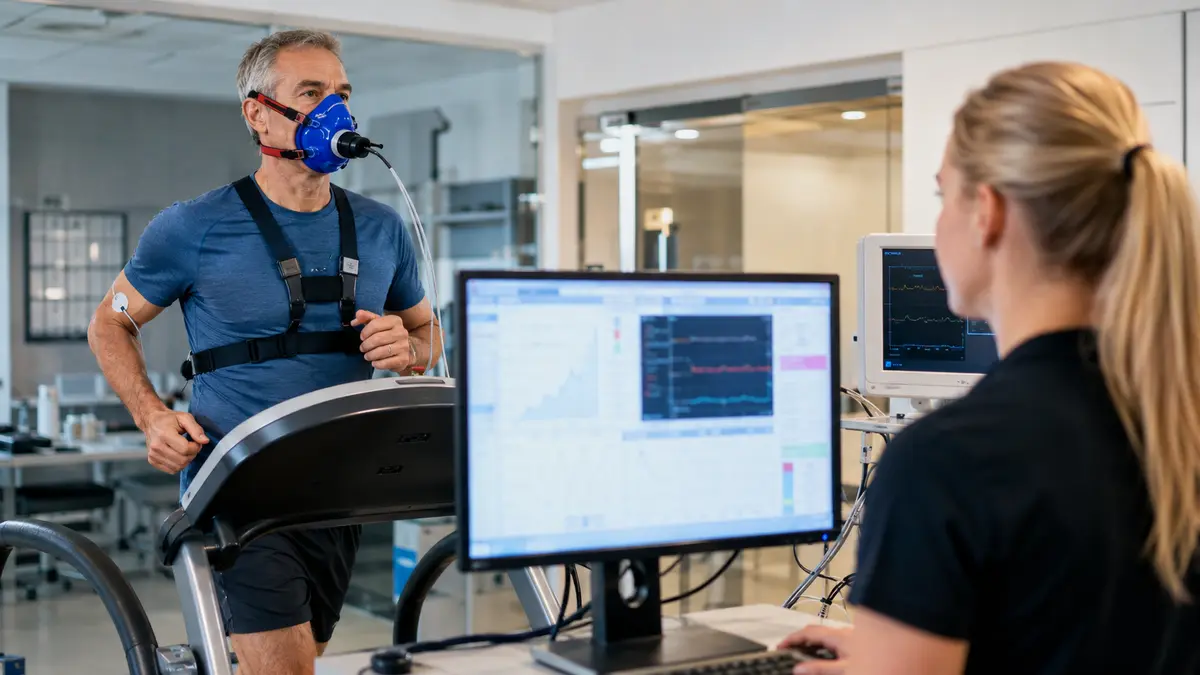
VO2 max describes oxygen use during very demanding exercise and can help researchers or clinicians assess fitness. For everyday decisions, the useful question is what a measurement adds to your understanding of function, not where it ranks you against younger people.
Fitness research and the limits of a single score
The 2018 fitness and mortality study followed 122,007 adults referred for treadmill testing at one medical centre. Researchers estimated peak exercise capacity from treadmill speed and grade; they did not measure each participant’s oxygen uptake directly. This retrospective observational study found associations, not proof that a particular exercise programme causes a longer life. It cannot validate a watch estimate or predict an individual lifespan.
Before reacting to a watch estimate, check its setup. Review the manufacturer’s instructions for your exact model, the supported activity type and the profile or sensor information the estimate uses. Garmin, for example, identifies profile and device-specific data requirements in its official VO2-max estimation guidance. A missing update or changed device is a reason to check the method, not a reason to push harder. Algorithm requirements are not a personal exercise prescription, and a configured watch still does not become a laboratory test.
Laboratory assessment and wearable estimates differ. A number can be useful when the method and purpose are clear, but it can distract from symptoms, realistic activity and the tasks you want to do.
Understand the measurement and plan repeatable activity
Understand the method
Why it matters: The meaning of a result depends on how it was obtained.
Practical application / what to track: Record whether it was measured during supervised testing or estimated by a device.
Pair it with function
Why it matters: Daily capability adds context that a score alone misses.
Practical application / what to track: Note a familiar task you want to find easier without turning it into a maximum-effort test.
Build a repeatable base
Why it matters: Consistency is a practical foundation for an activity plan.
Practical application / what to track: Choose a suitable routine and record effort and recovery before considering more intensity.
Discuss testing purpose
Why it matters: Not every reader needs a maximal fitness test.
Practical application / what to track: Ask what decision the assessment would change and whether supervision or adaptations are needed.
Fitness estimates and progression mistakes
- Comparing yourself with 20-year-old reference values.
- Treating a device fluctuation as a clinical change.
- Adding hard intervals before reviewing suitability.
Do not push through warning symptoms. Stop activity and seek help for new or unexplained symptoms. For possible heart-attack or stroke symptoms, fainting or severe breathing difficulty, call 911 or your local emergency number. A comfortable pace or watch reading does not guarantee safety.
Questions for your clinician about assessment, device estimates and symptoms
Use the questions that fit your situation. Keep personal health notes private and bring them through your clinic’s approved channel.
- Would a fitness assessment provide useful information for me?
- How should we interpret this device estimate alongside my symptoms and function?
- What progression is appropriate, and what should make me stop?
Next steps and related reading
Choose one useful next step rather than adding several new tasks at once.
Educational guidance. Not medical advice.
Zone 2 Cardio After 45: Benefits, Risks, and How to Start Safely
Compare ways to estimate exercise effort and questions about choosing a safe starting point.
Strength Training After 60: A Practical Beginner Framework
Explore five everyday movement patterns and questions to discuss before beginning strength training.
Daily Movement After 45: A Flexible Exercise Framework
Put aerobic activity, strength and balance into a flexible framework with a weekly review.
Evidence & Primary Sources
Original references and further reading are retained below. These include research and educational resources; inclusion is not a study-level appraisal or endorsement. See our evidence and editorial policy.
- HealthLink BC: Chest Problems and Warning Symptoms
- Canadian Society for Exercise Physiology: Canadian 24-Hour Movement Guidelines
- American Heart Association: Physical Activity Recommendations for Adults
- Research on cardiorespiratory fitness and mortality
- Passler et al.: Validity of Wrist-Worn Trackers for Estimating VO2 Max
Authorship and editorial disclosures. This editorial update does not claim a new independent medical review. Report a correction.
More in Movement · All Guides
FREE LIVING WELL STARTER KIT
Choose one useful next step.
A completed example, a two-week plan and tracker, plus an optional appointment sheet. Free to use without signing up.
Four printable or fillable pages. Choose one action that fits your life.