FOOD AND HEALTHY AGING
Longevity Diet Food List: What to Eat After 45
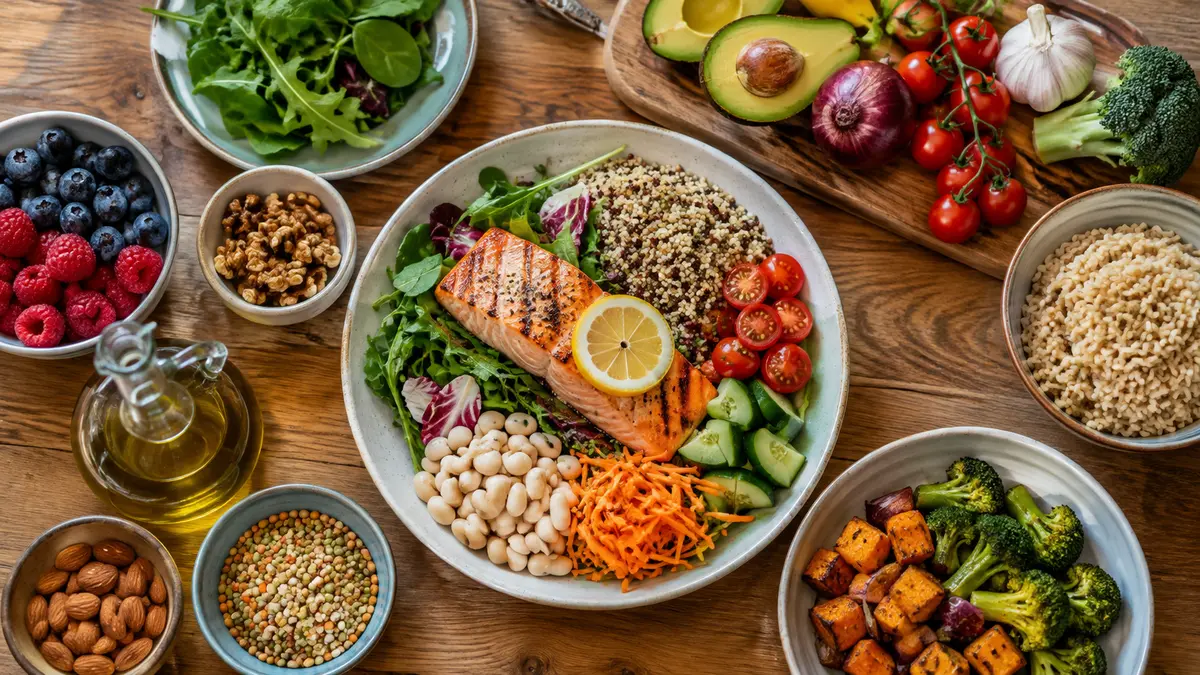
A useful longevity food list is a shopping and meal-planning aid, not a collection of miracle ingredients. Build meals you enjoy and can afford while protecting adequate nutrition, strength and everyday function.
The evidence and the problem
Canada’s Food Guide for seniors emphasizes varied foods and the practical circumstances of eating. No single food has been shown to stop aging.
A perfect menu is not useful if appetite, dental problems, preparation time or cost make it impossible. Start with a meal you already eat and identify one workable improvement.
A practical breakdown
Vegetables and fruit
Why it matters: Variety provides different nutrients and keeps meals interesting.
Practical application / what to track: Use fresh, frozen or suitable canned options; choose one you will actually prepare and eat.
Whole grains and legumes
Why it matters: These foods can add fibre and make meals satisfying.
Practical application / what to track: Try oats, whole-grain bread, beans or lentils as appropriate to your needs and tolerance.
Protein foods
Why it matters: Adequate protein is part of supporting muscle and nutritional status.
Practical application / what to track: Include options such as eggs, fish, tofu, yogurt or legumes; ask about individual needs rather than copying a gram target.
Fats and drinks
Why it matters: Small repeated choices shape the overall eating pattern.
Practical application / what to track: Consider unsaturated-fat sources and water within your personal dietary and fluid guidance.
A low-effort fallback
Why it matters: Convenient food can prevent an ambitious plan from becoming skipped meals.
Practical application / what to track: Plan one simple meal, such as a suitable grain, prepared protein and frozen vegetables; adapt for allergies and restrictions.
Protein pacing for healthy aging
Protein supports muscle maintenance, but it works alongside sufficient food, resistance exercise and recovery. More is not automatically better, and a rigid meal threshold is not required.
- A range to discuss
- For some healthy, active adults, particularly those resistance training, 1.2–1.6 g/kg/day can be a useful planning range. It is not a universal requirement for everyone over 45. PROT-AGE guidance for healthy adults over 65 starts at about 1.0–1.2 g/kg/day; needs differ with illness and activity.
- Worked example
- At 70 kg, 1.2–1.6 g/kg equals 84–112 g daily. Around 30 g at each of three meals provides 90 g. This illustrates the arithmetic, not an individual prescription.
- Distribute opportunities
- Include a protein-rich food at breakfast, lunch and dinner rather than trying to compensate with one oversized evening meal. Daily adequacy matters more than perfect timing.
- What about leucine?
- Leucine helps signal muscle protein synthesis. Research discussions often cite roughly 2.5–3 g in a meal for older adults, but there is no universal on/off switch. Other essential amino acids and total protein are also needed; a leucine supplement is not automatically necessary.
Choose foods you enjoy: dairy or fortified alternatives with useful protein, eggs, fish, poultry, tofu, tempeh, beans and lentils. Portions and protein amounts vary; use labels rather than treating every serving as equivalent.
Personalize first: kidney disease, frailty, unintended weight loss and other clinical circumstances can change the plan. Ask a clinician or registered dietitian which body-weight basis and intake fit you before pursuing a higher target.
Sources: PROT-AGE position paper; protein and resistance-training meta-analysis. These support context-specific planning, not a guaranteed sarcopenia-prevention dose.
Common mistakes and mindset guardrails
- Buying “anti-aging” ingredients instead of enough ordinary food.
- Ignoring appetite, dental health or unintended weight loss.
- Turning every food into a moral category. A sustainable pattern allows flexibility.
Primary care discussion checklist
Use the questions that fit your situation. Keep personal health notes private and bring them through your clinic’s approved channel.
- Do I have dietary restrictions or protein needs that should change this plan?
- Could appetite, chewing or weight changes need assessment?
- Would a registered dietitian help me make this affordable and manageable?
Next steps and related reading
Choose one useful next step rather than adding several new tasks at once.
Educational guidance. Not medical advice.
The Blue Zones Diet After 45: What the Research Suggests
Continue with a focused guide, then keep the questions relevant to your situation.
Gut Microbiome After 45: What Your Gut Bacteria Can and Can’t Tell You
Continue with a focused guide, then keep the questions relevant to your situation.
Strength Training After 60: A Practical Beginner Framework
Continue with a focused guide, then keep the questions relevant to your situation.
Evidence & Primary Sources
Original references and further reading are retained below. These include research and educational resources; inclusion is not a study-level appraisal or endorsement. See our evidence and editorial policy.
- Canada’s Food Guide: Healthy eating for seniors
- Heart & Stroke: The DASH diet
- Health Canada recommends a daily supplement containing 400 IU (10 micrograms) of vitamin D for adults aged 51 and older
- Heart & Stroke: An all-Canadian healthy diet
- U.S. National Institute on Aging: What do we know about healthy aging?
- World Health Organization: Healthy diet
- Canada’s Food Guide for seniors
Authorship and editorial disclosures. This editorial update does not claim a new independent medical review. Report a correction.
More in Nutrition · All Guides
FREE LONGEVITY STARTER KIT
Choose one useful next step.
A six-health-numbers checklist and a weekly habit planner, ready to use without signing up.
Email delivery is optional and includes occasional Fruitful Years emails. Unsubscribe anytime.